
Quick Summary
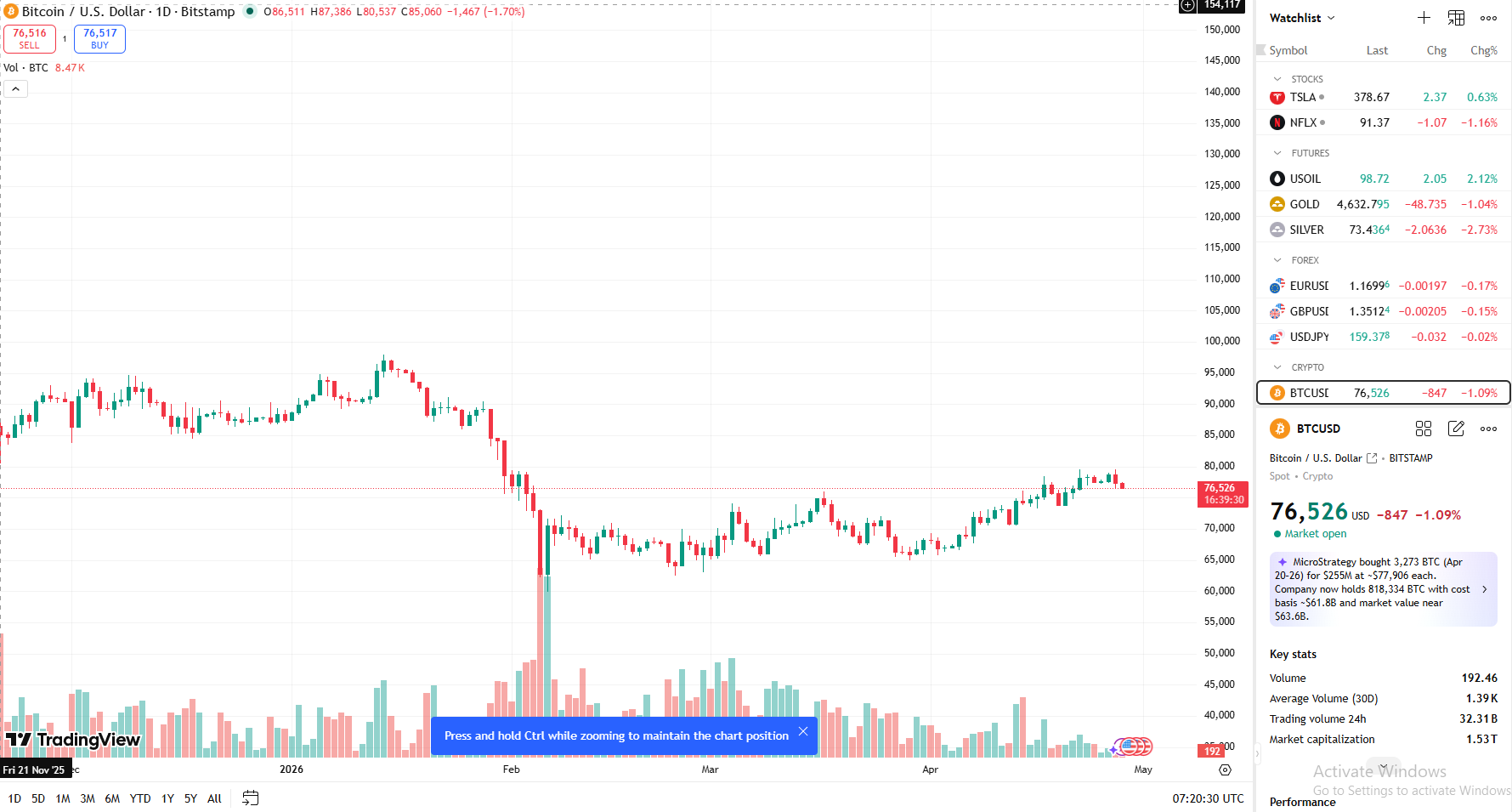
- Bitcoin stalled near $79,400 and has pulled back to around $77,000
- The Coinbase premium index has flipped negative for the first time since April 8 — a bearish signal
- The Bitfinex whale remains near cycle-peak long exposure at 79,342 BTC — historically a caution sign
- Bitcoin failed to reclaim the short-term holder realized price at $79,200
- Historical pattern: Bitcoin conferences tend to coincide with local price tops
Bitcoin’s Sunday night rally looked convincing at the time. A surge to $79,400 broke the market out of its multi-week range, sparked fresh bullish commentary across crypto social media, and briefly had traders eyeing the $80,000 psychological milestone. Then it stalled — and now, several closely watched indicators are flashing caution signals that suggest the short-term picture may have shifted.
With Bitcoin trading back around $77,000 at the time of writing, the question isn’t whether the rally happened — it did. The question is whether it has the legs to continue, or whether the market is setting up for a period of consolidation or a deeper retracement before the next leg higher. The on-chain data is leaning toward caution.
The Coinbase Premium Has Flipped Negative
Perhaps the most significant near-term warning signal is the flip in the Coinbase premium index, which turned negative for the first time since April 8 according to data from Coinglass.
For those unfamiliar, the Coinbase premium index measures the price difference between Bitcoin trading on Coinbase — the primary platform used by US institutional investors — and offshore exchanges like Binance. When the premium is positive, it signals that US institutions are paying more for Bitcoin than the rest of the world, which indicates strong demand from this cohort. When it flips negative, it suggests that US institutional buying has paused or reversed.
The context here makes the flip particularly meaningful. The Coinbase premium had been positive for 14 consecutive days — the longest streak since October — during which time Bitcoin climbed from $66,000 to $79,000. That sustained positive reading was one of the cleaner signals that the rally had genuine institutional demand behind it rather than being purely retail-driven speculation.
Now that the premium has moved to -0.04%, the market becomes more reliant on offshore flows to sustain momentum. Historically, Coinbase premium flips into negative territory have coincided with Bitcoin price pullbacks or periods of sideways consolidation. It doesn’t guarantee a significant correction, but it does remove one of the key support pillars that drove the recent rally.
The Bitfinex Whale Is Still Heavily Long
Another data point worth watching closely is the positioning of the so-called Bitfinex whale — a large, closely tracked entity on the Bitfinex exchange whose directional positioning has historically been a useful signal for Bitcoin price direction.
This entity currently holds 79,342 BTC in long exposure, just below its cycle peak of 80,100 BTC. The key observation here is behavioural: this whale typically reduces its long exposure once a local bottom is confirmed or when there is clear upside momentum to exit into. The fact that exposure remains near the cycle peak despite Bitcoin’s push toward $79,000 suggests one of two things — either this entity is exceptionally confident in further upside, or it hasn’t found sufficient price strength to justify reducing its position.
In past cycles, when this whale’s exposure has remained elevated near peaks while price rallies have stalled, it has preceded short-term consolidation or pullbacks. It’s a single data point and should be interpreted cautiously, but in combination with the Coinbase premium flip, it adds to the picture of a market that may be running out of short-term fuel.
Bitcoin Failed to Reclaim a Critical On-Chain Level
The third bearish signal comes from on-chain analytics. Bitcoin failed to reclaim the short-term holder realized price (STHRP), which currently sits at $79,200.
The STHRP is calculated as the average on-chain acquisition cost of coins held for fewer than 155 days — essentially, the average price that recent buyers paid for their Bitcoin. This metric matters because it defines the line between profit and loss for the most recent wave of market participants.
When Bitcoin trades above the STHRP, recent buyers are in profit, which tends to support positive sentiment and continued buying. When Bitcoin fails to reclaim it after a dip — as has just happened — it means recent buyers are still underwater on average. This cohort tends to be more reactive and more likely to sell into any bounce, capping recovery attempts and adding to selling pressure on the way down.
The longer Bitcoin remains below $79,200, the more pressure accumulates from this short-term holder cohort. Every failed attempt to reclaim that level reinforces the ceiling and increases the probability of continued downside or sideways price action.
Bitcoin On-Chain Signal Dashboard
| Signal | Reading | Implication |
|---|---|---|
| Coinbase Premium | Negative (-0.04%) | US institutional demand has paused |
| Bitfinex Whale Longs | 79,342 BTC (near peak) | No significant position reduction yet |
| STH Realized Price | $79,200 (not reclaimed) | Recent buyers still underwater on average |
| Current Price | ~$77,000 | Trading below key on-chain resistance |
The Bitcoin Conference Curse
There’s one more factor worth acknowledging, even if it’s more anecdotal than data-driven: the Bitcoin conference effect. The flagship Bitcoin conference in Las Vegas has now begun, and history offers a cautionary pattern for those expecting a conference-driven price surge.
Bitcoin conferences have a surprisingly consistent track record of coinciding with local price tops. The excitement, media coverage, and bullish commentary that surrounds these events can pull forward demand and create a sell-the-news dynamic as the event concludes. This isn’t a guaranteed outcome — markets don’t follow scripts — but it’s a pattern that experienced traders are aware of and factor into their positioning.
The fact that Bitcoin’s rally to $79,400 occurred just as the conference was getting underway, only to stall and pull back, fits neatly into the historical pattern. Whether it leads to a more significant pullback or simply a period of consolidation before the next leg higher remains to be seen.
What Bulls Need to See
None of the signals above guarantee a significant Bitcoin price decline. The broader macro picture — improving risk appetite, continued ETF inflows, and institutional adoption narratives — remains supportive of Bitcoin’s longer-term trajectory. But short-term, the market needs to see a few things to restore bullish momentum.
First, the Coinbase premium needs to recover back into positive territory, signaling a return of US institutional buying. Second, Bitcoin needs a convincing daily close above $79,200 — the short-term holder realized price — to flip recent buyers back into profit and reduce selling pressure. Third, the Bitfinex whale needs to either add to its position (signaling conviction in further upside) or begin reducing it (signaling a local bottom is in).
Until at least two of these three conditions are met, the short-term risk is skewed toward further consolidation or a retest of lower support levels. The $76,000–$77,000 range is the immediate support zone to watch, followed by $74,000 if selling pressure intensifies.
The Bigger Picture Remains Intact
It’s important to keep perspective here. Bitcoin has rallied from $66,000 to nearly $79,400 in a matter of weeks. A period of consolidation or a modest pullback after a move of that magnitude is entirely normal and healthy. Bull markets don’t move in straight lines, and short-term weakness in the context of a larger uptrend is not the same as a trend reversal.
The on-chain signals flashing caution right now are short-term in nature. The longer-term picture — Bitcoin ETF inflows at multi-month highs, institutional adoption continuing to accelerate, and the post-halving supply dynamics — remains supportive. For long-term holders, this is noise. For short-term traders, it’s a reason to be selective and patient rather than aggressively chasing moves higher.
The market has shown it can reach $79,000. The next test is whether it can hold above it — and the data says that test hasn’t been passed yet.
Key Levels to Watch
$79,200 — The short-term holder realized price and the level Bitcoin must reclaim to restore bullish momentum among recent buyers.
$79,400 — The recent swing high and the level that needs to be broken decisively to confirm continuation of the uptrend.
$76,000–$77,000 — The immediate support zone where Bitcoin is currently consolidating. A hold here keeps the short-term picture neutral. A break lower opens the path toward $74,000.
$74,000 — The next significant support level if current consolidation gives way to a deeper retracement.
Disclaimer: This article is for informational purposes only and does not constitute financial or investment advice. Cryptocurrency markets are highly volatile. Always conduct your own research before making any investment decisions. Bitcoin Bull Bear is not responsible for any financial losses incurred as a result of acting on information in this article.